17 May 2011


This is a particularly fine example of  a BT Godwit, still displaying the deep rufous colouring.

8 May 2011

Legal battle for bumblebee paradise

Buglife - The Invertebrate Conservation Trust is fighting to protect a wildlife haven on the Isle of Grain in Kent from a huge National Grid warehouse development. This bug paradise is home to a variety of beautiful, rare and endangered insects including a large population of threatened bumblebee species.

The Isle of Grain Hoo Peninsular, Kent, supports an exceptional area of Open Mosaic Habitat providing lots of pollen and nectar rich flowers, bare ground ideal for burrowing and basking insects and pools for aquatic beetles and bugs - a similar habitat to West Thurrock Marshes, a key wildlife site that Buglife fought to save in 2008The Isle of Grain is home to an array of special plants, reptiles, bumblebees, hoverflies and beetles. Important bumblebees present include the Brown banded carder-bee (Bombus humilis) and Shrill carder-bee (Bombus sylvarum). Also living on the Open Mosaic Habitat are the White eye-stripe hoverfly (Paragus albifrons), which until recently was believed to be extinct, and Mellet's downy-back beetle (Ophonus melletii), which is so rare that it has only been seen five times in the UK in the last 20 years.

Matt Shardlow, Buglife Chief Executive said 'The Isle of Grain is likely to be one of the most important sites in Britain for rare and endangered invertebrates. This is a bug paradise and National Grid's current plans to develop it into  a huge business park and lorry depot would destroy it.'

National Grid has already sprayed large areas of the site with pesticides, justifying this as an attempt to eliminate Brown-tail moths. This has resulted in the loss of flowering plants and bushes used by pollinating insects such as bumblebees White eye-stripe hoverfly (Paragus albifrons) (c) Mikel Tapia Arriada

Buglife have started a legal battle on behalf of the invertebrates inhabiting the site. In the first round of legal proceedings the judge agreed with Buglife that National Grid and Medway Council had failed to properly assess the impact on the wildlife of the site. The Judge concluded that National Grid must stop spraying the site with pesticides and allow the ecology to recover before undertaking further surveys to find out exactly how important the wildlife is. Despite the judge's support of Buglife's arguments he refused to allow Buglife to judicially review the planning permission.

Matt Shardlow responded 'We are pleased that the judge recognised the ecological importance of National Grid's land, and highlighted that the planning process has not

properly considered its importance, but we are not convinced that the proposal to just do more ecological assessments will save the animals. Buglife is appealing this decision; that is the right thing to do for the bumblebees and to ensure that future generations of people will benefit from the bee's diligent work pollinating flowers and crops'.

Dr. Ben Darvill, Director of the Bumblebee Conservation Trust said "The Thames Gateway is of national importance for rare bumblebees with populations hanging on in flower-rich pockets of habitat. The Isle of Grain is a very important site and if it is destroyed or degraded the whole population structure could collapse."


Buglife - The Invertebrate Conservation Trust is the only charity in Europe devoted to the conservation of all invertebrates, and is actively working to save Britain's rarest bugs, bees, butterflies, ants, worms, beetles, snails and many more fascinating invertebrates. Further information is available on Buglife's website at www.buglife.org.uk

.The site is 164 hectares in total; over 100 hectares of important habitat for rare and endangered invertebrates will be destroyed or degraded by the development. The development has not been designed to avoid the most valuable areas open mosaic habitat.Normally one would expect several weeks of survey work on an area of this potential significance .A one day survey as part of the Environmental Impact Assessment found an outstanding 258 species; 13 of which are Red Data Book, 23 Nationally scarc, 4 have UKBAP status and 11 are to beof rare or accasional occurrance.

The East Thames Corridor region currently supports one of the most important remaining metapopulations of the Brown banded carder-bee (Bombus humilis) and Shrill carder-bee (Bombus sylvarum) in the UK, but many sites are already lost or under direct threat of development. Bumblebee populations appear to operate at a landscape scale and it is probable that viable individual populations require minimum ranges of between ten to twenty km2 of good matrix habitat, including several large patches of flowers within these range areas. A thriving population of bumblebees will require dozens of active nests and tens of hectares of suitable habitat.

Mellet's Downy-back beetle (Ophonus melletii) is a UKBAP priority species. This beetle has declined more than 50% over the last 25 years, and there have only been five records in the last 20 years, one of which was from Rochester (N Kent), finding this beetle on site is very significant.

White eye-stripe hoverfly (Paragus albifrons) is a very rare species. Hoverfly experts were poised to declare this species as extinct, but it is now known to survive on two brownfield sites in the Thames Gateway. The ecological requirements of this species are not fully understood.

30 Apr 2011

A Yellow Wagtail

Trip out to a Boot fair on Sheppey this morning 30-4-2011 on the way back, decided to drive up as far as the farm at Elmley  the Yellow Wag and The Little Grebe were my reward for no effort.

Paired up Redshank

These birds are at the moment are very visible at RSPB Elmley and if patient some good shots can be had.
Not sure what the object of this exercise was about, but whatever it was he was intent on collecting a hell of a lot of these reeds, the nest was already built as seen in the previous shot, perhaps he decided on a holiday home.

Nesting at Elmley

28 Apr 2011

A Holly Blue

This Holly Blue would not open it's wings.

A lovely field of Buttercups

Taken at Cuxton.

A Speckled Wood


Taken in the woods at Upper Halling

20 Apr 2011

Upper Halling wonderful day

Today Upper Halling nice to have had a chat with you and mum my email is pixelman@btinternet.com
apologies for not  knowing your name.

Results of a couple of mornings.

Had a couple of trips out Sat 16th birding and bootfair, yesterday on my own did my usual Leysdown, Harty, and RSPB Elmley, the Saturday trip was quite unimpressive regarding species but yesterday was much improved, had a couple of hours with the Avocets the numbers available to watch were depleted by two thirds on the Wellmarsh scrape compared to a week ago, the water level is in my opinion a little to high and is not ideal for avocet feeding although I hope this is not the reason for their absence.


Three Swallows were sighted and two Blackcap were singing in the orchard, a Spoonbill flew overhead and one was visible at distance from the hide, a Lapwing had become prey to something by the side of the track, Skylarks and Corn Buntings were showing well, but the star of the day was without doubt the Ring Ousel a first ( don't do ticks) sighting for me.

Below are a few pics taken over the two days .

Coot

Taken at Elmley just off the track.

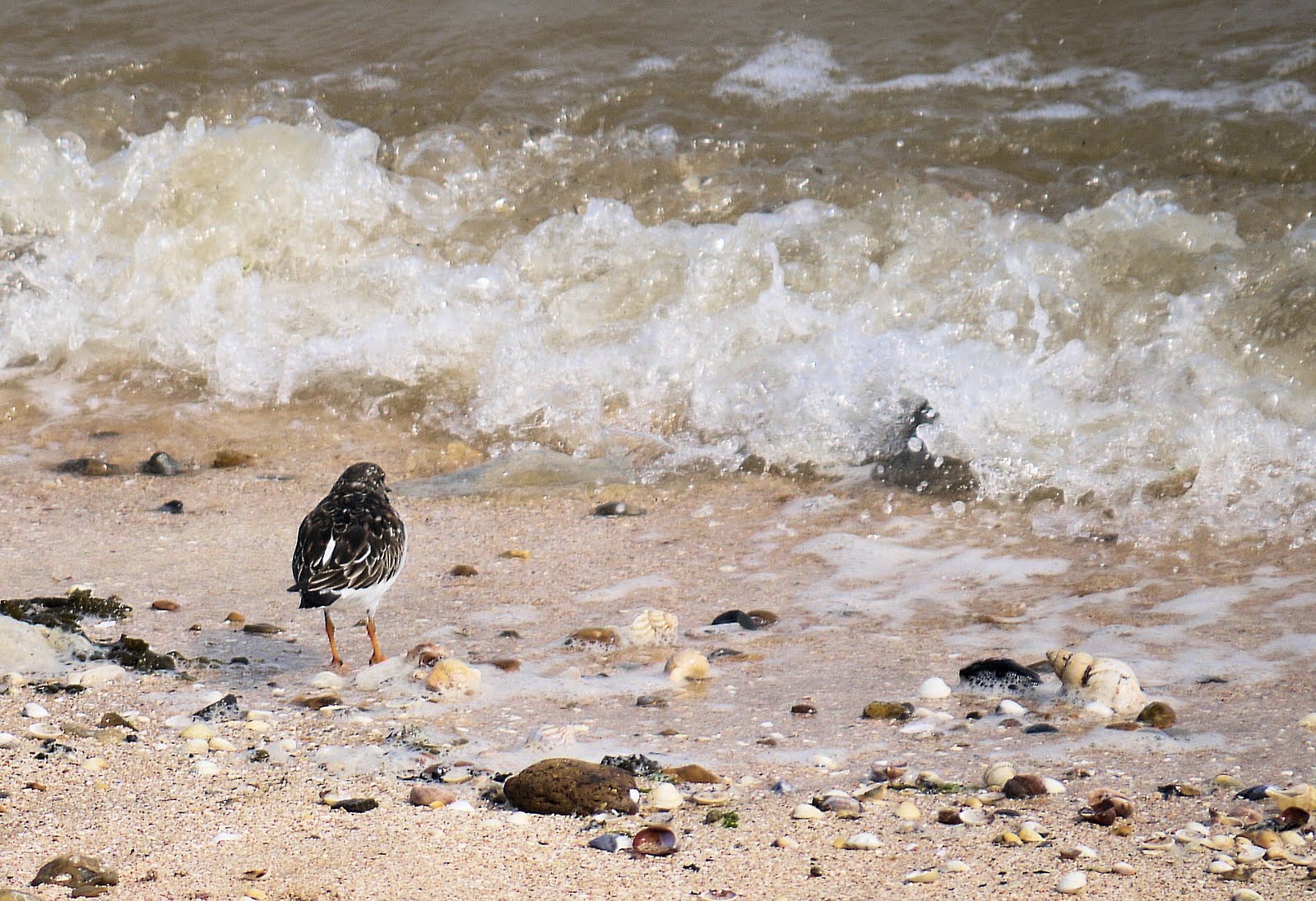
Turnstone at rest

These four pictures were taken at Leysdown

Lone Turnstone

Feral Pigeons

They may be feral and some people regard them as flying rats and disease ridden, and they are the staple diet of peregrines but tat does not make them any the less a handsome creature.

The Harty Road

Oystercatcher

With nesting in mind at RSPB Elmley.

Two Blackbacks

Not sure about these two, but they did seem to be oblivious of the busy world around them.
.
A wee bit corny I know but it's not often you get to see a Swan in such detail.

12 Apr 2011

Great Day out yesterday 11.4.011

Bernie I hope you enjoyed your trip to our patch, Sheppey, you were treated to a good representation of our Avocets going about their role in life, courtship and procreation, we were fortunate as they have only been here a few days. and I am sure Roger has been the perfect host and has shown you around as much as was possible in the time you were here, by the time you get wind of this you will be back in darkest Suffolk performing your conservation work, well done!.


Roger our mystery bird has I think has more than an association with the Mallard populous, these birds seem to be very prolific in hybridisation producing all sorts of strange markings and colour variations, I have published a couple of shots below and will be forwarding the same to Gordon Allison, but like the gentleman that joined us said, he does not think the bird will draw many of the bird fraternity to a viewing.

We spoke of creating a site in which you both seemed keen, this is very possible at no cost, we will discuss further, in the meantime think of a suitable name. I will be in touch via email and will forward my telephone number so that we can go into much more detail.

TTFN

Dave

The pictures posted are yesterdays visit 11-4-011 and a previous time a week ago.

An Enigma.

Heron with ditch carp.

This Grey Heron had one hell of a job with this Carp, it is one of a series I shot at RSPB Elmley.

Just looking elegant.

Redshank displaying

There are a reasonable amount of these birds nesting on the Elmley reserve

Courtship, the approach

The act

Lets go build a nest.

2 Apr 2011

April 1st

A sudden impulse led to a trip to Oare and Elmley, the weather was dull and blustery and would add not conducive to photography at least detailed stuff, however not deterred we arrived at Oare, it did start to brighten up, and the observation was, not a lot about, couple of BT Godwits a few Greylag, Tufted Duck, a few Wigeon and Teal, and I suppose if pressed the star of that show was a very obliging Little Grebe, I usually manage to photograph the rear end of the bird as it disappears under water, when feeding they are busy little creatures.


On to Elmley and drove to the Wellmarsh hide at this time 11-30 we were the only visitors to the reserve. I noticed enroute quite a number of Curlew, way out on the marsh other than that, about a dozen pairs of Mute Swans throughout the reserve, and the numbers of Little Egret seem to be more abundant than usual , two Brown Hares had a confrontation, and the result was that they took off in opposing directions.

From the hide, still a great deal of water with very little roosting space, I was there well before high water and what birds there were are already here 100+ Dunlin 30 or so Turnstone, 1 Avocet 3 Black Tailed Godwit, 4 Ringed Plover, and a very distant Spoonbill. The Dunlin were very skittish and were alarmed a few times never spotted the reason. High water came and went not producing no more birds.

We then went to Queenborogh and had fish and chips which we consumed by the harbour and then home, all in all quite a pleasant trip.

Spoonbill

This bird was so near to the Sheppey, Eastchurch open prison that it spurred the thought that so often have I seen Marsh and Hen Harrier, Buzzard and now this Spoonbill in the vicinity of the prison, made me think whether any of the inmates would be interested in wildlife I do not see why not, they are ideally situated, I would like to think yes, and perhaps possibly have a birding club, I wonder, may drop them a line to perhaps confirm

Over Eastchurch open prison.

Little Grebe

This rather pleasant little bird I pictured at Oare, Faversham.

Fancy seeing you !